

For many years, I struggled with unstable grinding efficiency in vertical mills. Wear was fast. Power use was high. Shutdowns came too often. Traditional alloy rollers looked strong, but they failed early. This gap between expectation and reality pushed me to rethink the grinding surface itself.
Ceramic particles improve grinding efficiency by increasing hardness, reducing wear, and keeping stable grinding conditions under high load. They help me achieve finer particles with lower power and longer service life in vertical mills.
I did not change everything at once. I started by understanding why ceramic particles behave so differently in real mill operation. Once I saw the results, I knew this was not just a material upgrade. It was a system upgrade.
Why Does My Vertical Mill Need Ceramic Particles Instead of Traditional Alloy Materials?
Traditional alloy rollers promise strength, but they often fail under real mill stress. I have seen cracks form early. Wear becomes uneven. Vibration increases. These problems never fully go away with alloy materials.
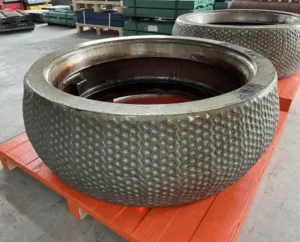
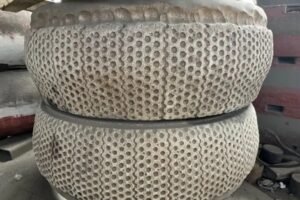
Ceramic particles provide much higher hardness than traditional alloys while keeping strong bonding with the metal matrix. This allows the grinding surface to resist wear without becoming brittle.
In my experience, the key difference is how stress is handled. Alloy materials rely on bulk strength. Once microcracks start, failure spreads fast. Ceramic particles work differently. They act as many small hard points embedded in steel. Each particle takes part of the load. Stress spreads instead of concentrating.
| Aspect | Alloy Roller | Ceramic Composite Roller |
|---|---|---|
| Durezza | Medio | Very high |
| Crack resistance | Limited | Strong |
| Wear pattern | Uneven | Uniform |
| Load distribution | Concentrated | Dispersed |
This structure allows my vertical mill to grind harder materials with less surface damage. Over time, grinding efficiency stays stable instead of slowly dropping.
How Do Ceramic Particles Reduce Wear Rate in My VRM Roller Sleeves?
Wear is the silent cost of vertical mills. I have replaced too many rollers simply because wear got out of control. Alloy surfaces polish, groove, and peel under long-term grinding.
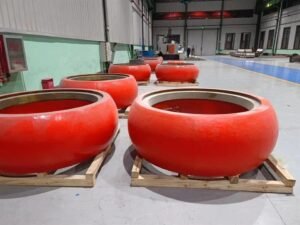
Ceramic particles reduce wear rate by resisting abrasion and protecting the metal matrix from direct contact with raw material.
Ceramic particles are harder than clinker, slag, or quartz. When these materials pass through the grinding zone, they cannot cut into the surface easily. Instead, they fracture. This shifts wear from the roller to the material itself.
| Wear Factor | Alloy Surface | Ceramic Composite |
|---|---|---|
| Abrasive cutting | Alto | Very low |
| Surface polishing | Fast | Slow |
| Profile loss | Severe | Minimal |
Because wear slows down, the roller profile stays stable. Grinding pressure remains even. This directly improves grinding efficiency over long campaigns without frequent adjustment.
How Can Ceramic Particles Help Me Achieve More Stable Mill Operation?
Mill stability is not only about control systems. It starts at the grinding interface. I have seen mills vibrate badly even with perfect parameters because the roller surface was unstable.
Ceramic particles stabilize operation by creating a consistent grinding surface that resists uneven wear and sudden damage.
When alloy rollers wear unevenly, pressure distribution changes. This causes vibration, noise, and sudden load spikes. Ceramic composite rollers wear slowly and evenly. Load stays balanced across the table.
| Stability Factor | Alloy Roller | Ceramic Composite |
|---|---|---|
| Vibration risk | Alto | Basso |
| Load fluctuation | Frequent | Rare |
| Parameter drift | Fast | Slow |
With stable grinding conditions, I can run closer to design capacity. Operators feel safer. Control becomes simpler. This stability alone saves time and energy every day.
Why Does Ceramic Reinforcement Extend the Service Life of My Grinding Rollers?
Service life is not just about hardness. I learned this the hard way. Some very hard alloys failed early due to cracking.
Ceramic reinforcement extends service life by combining hardness with crack resistance and impact tolerance.
Ceramic particles block crack growth. When a crack tries to move through the metal, it meets hard ceramic phases. The crack loses energy and stops. This prevents sudden failure.
| Life Factor | Alloy Roller | Ceramic Composite |
|---|---|---|
| Crack propagation | Fast | Restricted |
| Impact tolerance | Medio | Alto |
| Total service hours | Short | Long |
This is why ceramic composite rollers often last two to two and a half times longer. For me, fewer replacements mean fewer shutdowns and lower risk.
How Do Ceramic Particles Improve My Mill’s Resistance to Cracking and Impact?
Vertical mills face constant impact from feed size variation. I have seen large clinker pieces destroy alloy surfaces in minutes.
Ceramic particles improve crack and impact resistance by sharing stress and preventing localized overload.
Instead of one large metal area absorbing impact, many ceramic particles work together. Each particle carries part of the force. The metal matrix stays protected.
| Impact Scenario | Alloy Roller | Ceramic Composite |
|---|---|---|
| Large feed lumps | High damage | Limited damage |
| Thermal shock | Crack risk | Stable |
| Sudden load | Failure risk | Controlled |
This makes ceramic composite rollers safer for real-world operation where feed conditions are never perfect.
Can Ceramic Composite Roller Sleeves Lower My Maintenance and Shutdown Costs?
Maintenance cost is often hidden until the year-end report. I used to focus only on purchase price. That was a mistake.
Ceramic composite roller sleeves lower costs by reducing wear, extending service life, and cutting unplanned shutdowns.
Longer life means fewer replacements. Stable operation means fewer emergency stops. Maintenance planning becomes predictable.
| Cost Item | Alloy Roller | Ceramic Composite |
|---|---|---|
| Replacement frequency | Alto | Basso |
| Emergency repair | Common | Rare |
| Annual downtime | Long | Short |
When I calculated total cost instead of unit price, ceramic composite solutions were clearly cheaper.
How Do Ceramic Particles Maintain Grinding Efficiency Under High Load Conditions?
High load is where many mills fail to perform. Power goes up. Efficiency goes down. Wear accelerates.
Ceramic particles maintain efficiency under high load by keeping their hardness and shape even under extreme pressure.
Alloy materials soften slightly with heat and stress. Ceramic particles do not. This keeps grinding action sharp and consistent.
| Load Condition | Alloy Roller | Ceramic Composite |
|---|---|---|
| High pressure | Efficiency drops | Efficiency stable |
| High temperature | Softening risk | Stable |
| Long campaigns | Degradation | Consistent |
This allows me to push throughput without sacrificing grinding quality.
Why Is Metal Ceramic Composite Technology Better for My Cement and Coal Mills?
Cement and coal mills have different materials, but the same problem. Wear, cracking, and instability.
Metal ceramic composite technology combines toughness and hardness in one structure, making it ideal for both applications.
The metal absorbs shock. The ceramic handles abrasion. Together, they outperform single-material solutions.
| Application | Key Challenge | Composite Advantage |
|---|---|---|
| Cement | Hard clinker | High abrasion resistance |
| Coal | Impact and heat | Crack resistance |
This balance is why I see better long-term performance across different mills.
How Can I Select the Right Ceramic Composite Solution for My Vertical Mill Application?
Not all ceramic composites are the same. I learned that selection matters as much as the material itself.
The right solution depends on material hardness, feed size, load level, and operating hours.
Key factors I always review include ceramic size, distribution, bonding quality, and past application data.
| Selection Factor | What I Check |
|---|---|
| Feed hardness | Ceramic grade |
| Impact level | Metal matrix toughness |
| Operating hours | Wear design |
| Supplier support | Field experience |
Working with Dafang-Casting, I rely on real mill data, not lab promises.
Conclusione
Ceramic particles have changed how my vertical mills perform. Grinding efficiency stays high. Wear slows down. Operation becomes stable and predictable. With Dafang-Casting’s metal-ceramic composite technology, I achieve longer service life, lower costs, and safer operation in cement and coal mills.
 Italian
  English
  Arabic
  Danish
  German
  Spanish
  Finnish
  Hindi
Hindi  Hebrew
  French
  Hungarian
  Indonesian
  Korean
  Dutch
Dutch  Portuguese
  Vietnamese
  Thai
Thai